
Smart-Grid Integration: The Future of Energy-Resilient Living in California
The New Macroeconomic Reality of Los Angeles Real Estate
The macroeconomic landscape for multi-family real estate development in Southern California has reached a critical inflection point in 2026. Institutional investors and private equity partners are no longer evaluating assets solely through the traditional lenses of location and raw square footage. Rapidly escalating utility costs, strict municipal decarbonization mandates, and an increasingly volatile electrical grid have elevated energy infrastructure into a primary driver of asset valuation.
Under the leadership of CEO Lara Okunubi, Ideal Residence is actively redefining the parameters of institutional-grade multi-family assets. By moving beyond passive sustainability and embracing active smart-grid integration, we are establishing a new benchmark for risk mitigation and long-term asset preservation in urban Los Angeles.
De-Risking Urban Development via the Crenshaw Corridor Case Study
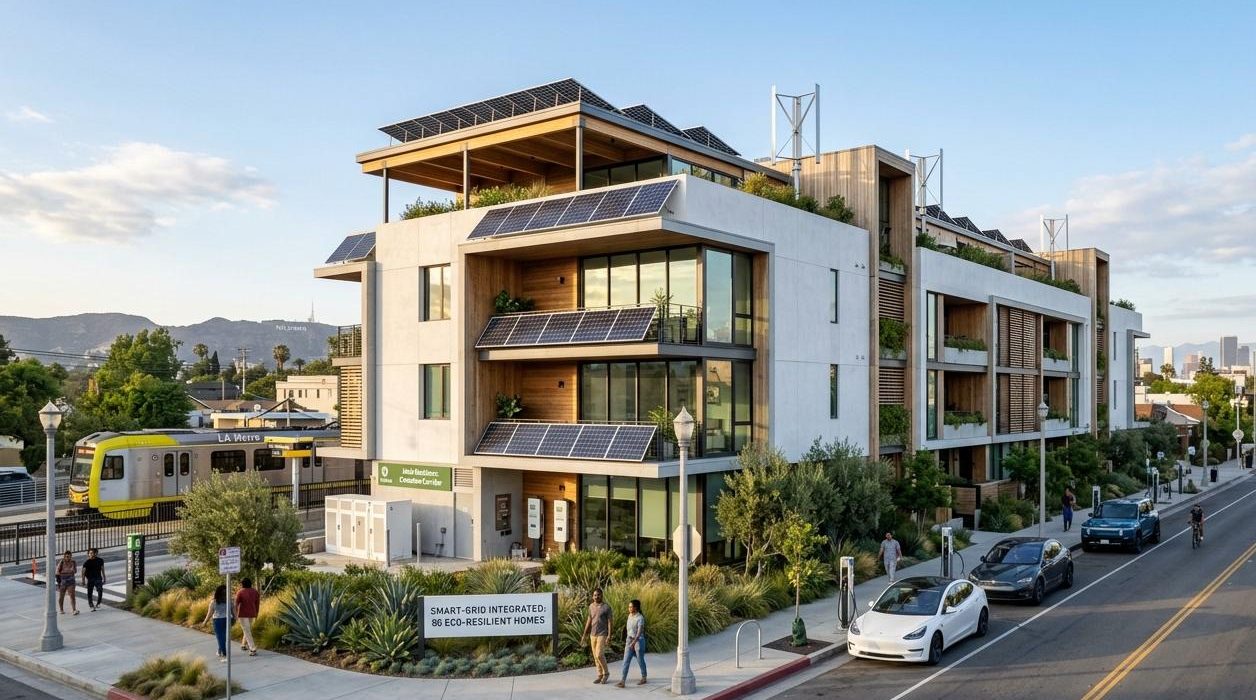
The practical application of this forward-looking investment philosophy is best demonstrated by our signature transit-oriented development (TOD) project in the heart of South L.A.’s Crenshaw Corridor. This upcoming 7-story, 80-unit mixed-use development represents a paradigm shift in how high-density housing interacts with regional infrastructure. Leveraging the City of Los Angeles Transit-Oriented Communities (TOC) Incentive Program, the project maximizes Floor Area Ratio (FAR) bonuses to achieve institutional scale while baking structural energy resilience directly into the building’s core.
Located adjacent to the critical K Line infrastructure, this asset is designed from the ground up to operate as an independent, grid-interactive microgrid. For commercial lenders and equity partners, this technical capability directly translates into the structural de-risking of the property’s operational profile.
Driving NOI by Optimizing OpEx and Energy Arbitrage
Smart-grid integration directly impacts a property’s financial statements by radically optimizing Operating Expenses (OpEx) and expanding Net Operating Income (NOI). Traditional multi-family assets remain entirely exposed to the financial liabilities of peak-load pricing and unpredictable brownouts. Our Crenshaw Corridor asset counters this vulnerability through a sophisticated energy architecture combining:
-
On-site rooftop photovoltaic (PV) generation arrays.
-
Commercial-grade battery energy storage systems (BESS).
-
Automated, AI-driven demand-response software systems.
       [On-Site Solar Arrays] ---> (Clean Energy Generation)
                                             |
                                             v
[Automated Demand-Response] <---> [Battery Storage (BESS)] ---> (Peak Shaving / Grid Export)
                                             |
                                             v
                                {Reduced OpEx & Elevated NOI}
By utilizing localized battery storage, the building dynamically deploys energy arbitrage strategies—storing low-cost power during off-peak hours and utilizing or exporting it during expensive peak demand periods. This structural mitigation shields the asset from volatile municipal utility rates while creating an entirely new, non-traditional ancillary revenue stream through localized grid-stabilization programs.
Navigating the Southern California Regulatory Landscape
Compliance with evolving environmental mandates is a mandatory requirement for preserving terminal asset value. Properties that fail to adapt run the immediate risk of regulatory obsolescence and steep municipal penalties. Ideal Residence’s smart-grid framework exceeds the rigorous demands of the latest CalGreen Building Standards, positioning our portfolio well ahead of state-level net-zero targets.
Furthermore, in an investment climate influenced by local measures such as Measure ULA, developers must maximize structural efficiencies to offset increased transactional frictions. Our eco-resilient design choices directly lower insurance premiums, command premium rents from climate-conscious urban professionals, and significantly enhance capital appreciation metrics upon eventual asset disposition.
The Institutional Conclusion: Capitalizing on the Future L.A. Skyline
The future of the Los Angeles skyline belongs to self-sustaining, grid-interactive real estate assets that actively protect investor capital from macroeconomic and environmental shocks. Smart-grid integration is no longer a speculative premium amenity; it is an institutional necessity for modern portfolio construction. Ideal Residence remains uniquely positioned at the intersection of progressive municipal policy, disciplined capital allocation, and advanced sustainable engineering. We invite qualified institutional joint-venture partners to engage with our executive team as we scale these high-performing, energy-resilient multi-family assets across Southern California’s most vital transit corridors.
