
Destination Crenshaw: When Cultural Infrastructure Becomes the Commercial Valuation Anchor
Lara Okunubi | CEO, Ideal Residence
As we navigate the complexities of the 2026 Los Angeles real estate landscape, traditional valuation models are being fundamentally re-evaluated. While cap rates and interest rate fluctuations dominate quarterly reports, a more profound shift is occurring on the ground in high-growth submarkets like South L.A. Proximity to transit is no longer the sole determinant of premium asset performance.
Institutional capital is increasingly flowing toward submarkets defined by strong cultural identities and substantial public-sector infrastructure investment. Nowhere is this symbiotic relationship between culture and commerce more evident than the Crenshaw Corridor, driven by the transformative influence of Destination Crenshaw.
This paradigm, which we at Ideal Residence define as the “Destination Crenshaw Effect,” is redefining risk-adjusted returns by embedding long-term commercial value directly into the cultural fabric of a community.
The Economics of “Place-Keeping” as Asset De-Risking
For decades, rapid urban development often resulted in displacement, eroding the unique cultural equity that made neighborhoods attractive in the first place. Destination Crenshaw flips this script. By investing in 1.3 miles of public art, innovative landscaping, and pedestrian-centric infrastructure, it creates a powerful “place-keeping” mechanism.
From an institutional perspective, this investment in cultural infrastructure acts as a formidable de-risking strategy. It signals a long-term commitment to the corridor, stabilizing the neighborhood and fostering organic commercial demand. It transitions a location from mere “transit-oriented” to a “cultural destination.“
For developers and investors, this infrastructure provides a significant tailwind, enhancing the desirability of adjacent parcels and driving substantial increases in long-term asset valuation.
Catalyst for NOI Growth and Community Stability
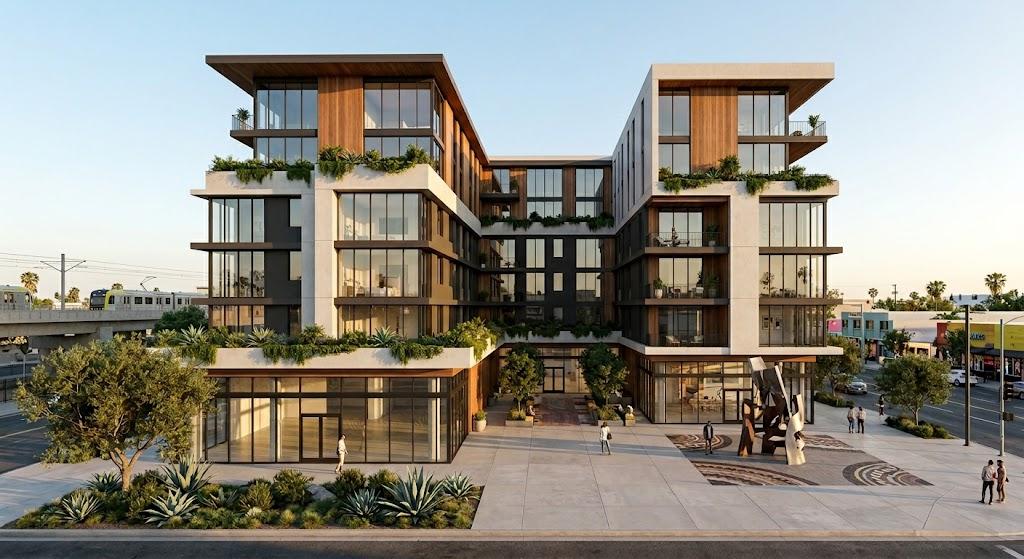
Ideal Residence is explicitly capitalizing on this effect with our upcoming 7-story, 80-unit mixed-use project, located just steps from the new K Line and Destination Crenshaw’s major anchors. We are not merely developing units; we are integrating our project into a thriving cultural ecosystem.
The enhanced public realm creates several direct levers for driving Net Operating Income (NOI). Improved pedestrian flow increases the viability and value of ground-floor retail, which often struggles in car-centric L.A. submarkets. Our data projects a premium on retail lease rates compared to projects outside the cultural zone.
Furthermore, a culturally rich environment improves residential retention, lowering turnover costs (OpEx) and stabilizing the top line. Residents are not just renting square footage; they are buying into a narrative and a vibrant, sustainable lifestyle that is intrinsically tied to the local heritage.
Leveraging Progressive Policy for Sustainable FAR Bonuses
While culture is the driver, execution requires navigating L.A.‘s rigorous development framework. The Destination Crenshaw Corridor is a high-priority zone for the City’s Transit-Oriented Communities (TOC) Incentive Program.
Ideal Residence projects aggressively utilize Tier 3 and 4 TOC bonuses, maximizing Floor Area Ratio (FAR) to achieve densities essential for institutional-grade projects. We seamlessly integrate these density bonuses with CalGreen Building Standards to deliver eco-resilient assets.
Our Crenshaw project incorporates smart-grid readiness and optimized sustainable systems, further reducing OpEx and future-proofing the asset against accelerating ESG mandates and future Measure ULA-style transaction taxes. We deliver assets that are efficient, sustainable, and deeply desirable to tenants, all of which compounds into superior asset valuation.
Conclusion: The Future of Urban Investment is Cultural Integration
The future of the Los Angeles skyline will be shaped by a synthesis of density, sustainability, and authenticity. Projects that ignore the local cultural context will increasingly face market friction.
For institutional partners and private equity investors, the window to capture maximum value from this cultural inflection point is now. The Destination Crenshaw Effect isn’t just theory—it’s a multi-decade investment thesis validated by public commitment. Ideal Residence is delivering the institutional vehicles necessary to deploy capital efficiently into this transformative cultural ecosystem. We invite you to join us in defining the future of responsible, culturally driven urban development.
