
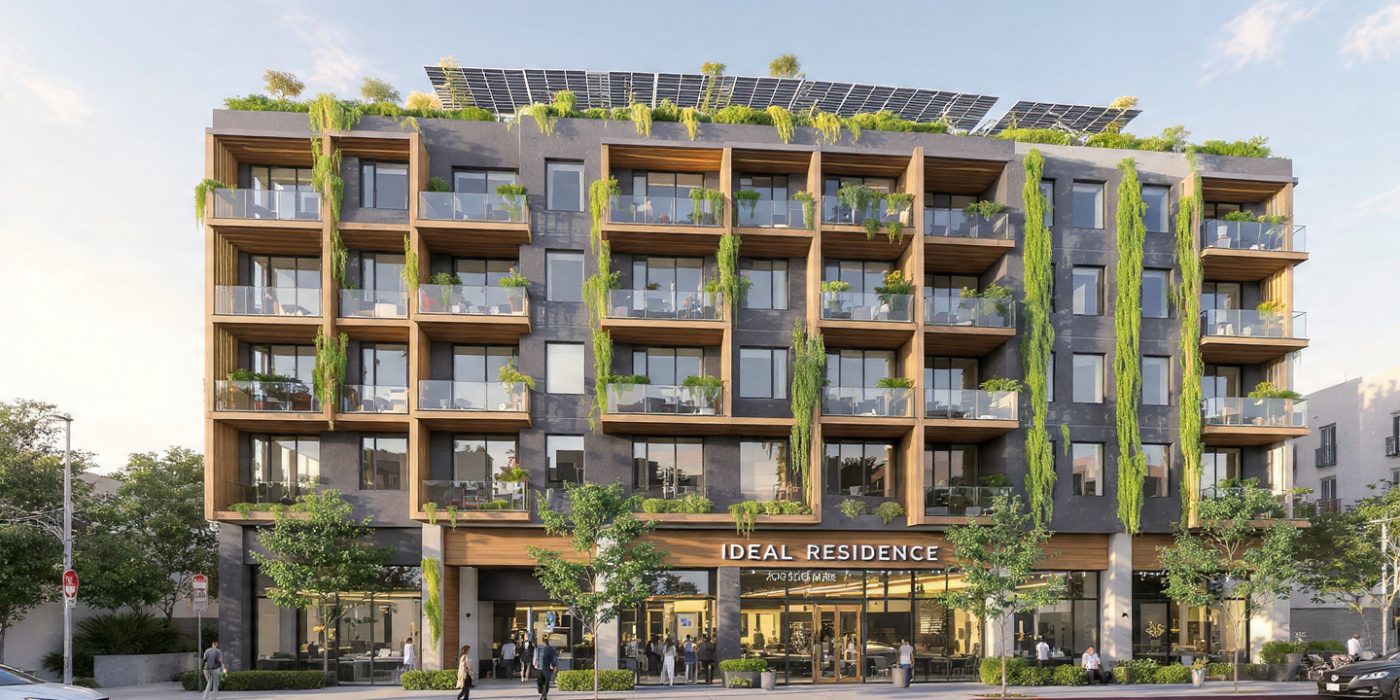
The Los Angeles multi-family housing market is navigating a complex macroeconomic landscape. Institutional investors face a unique combination of strict local regulation, evolving tenant demands, and high municipal transaction costs.
In this climate, traditional development paradigms are yielding diminishing returns. True asset insulation requires looking beyond simple square footage. Forward-thinking capital is prioritizing high-performance, net-zero development as the ultimate mechanism for risk mitigation and capital preservation.
At Ideal Residence, we view sustainable housing not as an idealistic choice, but as a rigorous strategy to protect long-term financial returns. Under the leadership of CEO Lara Okunubi, our investment thesis focuses on building eco-resilient design into structurally changing submarkets. By eliminating fossil fuel dependence and optimizing resource efficiency, we protect our portfolios from volatile energy costs and tightening state climate mandates.
The Economics of Eco-Resilient Design: Expanding NOI and Slashing OpEx
For institutional real estate portfolios, the primary argument for net-zero assets lies in the direct optimization of Net Operating Income (NOI). Traditional multi-family assets face highly volatile utility costs and rising municipal service fees. Net-zero buildings insulate ownership from these shifts by lowering variable Operating Expenses (OpEx) through localized energy infrastructure.
+-------------------------------------------------------------+
|               TRADITIONAL VS. NET-ZERO NOI                  |
+-------------------------------------------------------------+
| TRADITIONAL MULTI-FAMILY      | NET-ZERO ASSET DEPLOYMENT   |
|                               |                             |
| Gross Rental Income           | Gross Rental Income         |
| (-) Volatile Grid Utilities   | (-) Low Smart-Grid OpEx     |
| (-) Escalating Carbon Taxes   | (-) Zero Carbon Penalties   |
| (-) Standard Maintenance      | (-) Predictive Maintenance  |
| = Volatile / Lower NOI        | = Expanded / Stabilized NOI |
+-------------------------------------------------------------+
Integrating solar arrays, high-efficiency heat pumps, and localized water-reclamation systems minimizes grid reliance. When these physical components connect to smart-grid integration software, the property dynamically balances energy loads. This approach turns energy from a volatile liability into a highly predictable, manageable operational cost.
High-performance building envelopes do more than cut carbon; they fundamentally de-risk the asset by replacing unpredictable utility liabilities with stable, long-term operational efficiency.
Furthermore, eco-resilient systems protect physical assets from extreme weather events. Incorporating passive cooling techniques, advanced insulation, and robust stormwater management systems lowers insurance risk profiles. In an era where commercial lenders look closely at climate vulnerability, net-zero construction preserves long-term asset valuation.
Navigating the Southern California Regulatory Gridlock
Los Angeles features some of the strictest municipal real estate frameworks in the United States. Between the financial impacts of Measure ULA and the evolving requirements of the CalGreen Building Standards, standard development tracks face heavy friction. Success in this market requires aligning projects with municipal goals to unlock structural planning advantages.
Utilizing the Transit-Oriented Communities (TOC) Incentive Program allows developers to bypass standard density and parking bottlenecks. By placing projects near major transit hubs, developers can access valuable Floor Area Ratio (FAR) bonuses. These allowances maximize rentable square footage while reducing the cost of expensive subterranean parking structures.
       +-------------------------------------------------------+
       |           REGULATORY ADVANTAGE LIFTCYCLE              |
       +-------------------------------------------------------+
       |  CalGreen Compliance & Transit-Adjacent Site Selection |
       +-------------------------------------------------------+
                                   |
                                   v
       +-------------------------------------------------------+
       |   Unlock TOC Tier Incentives & FAR Density Bonuses    |
       +-------------------------------------------------------+
                                   |
                                   v
       +-------------------------------------------------------+
       | Accelerated Municipal Entitlements & Shorter Timelines|
       +-------------------------------------------------------+
                                   |
                                   v
       +-------------------------------------------------------+
       |  Reduced Carry Costs & Faster Path to Stabilization  |
       +-------------------------------------------------------+
Focusing on net-zero performance also shortens entitlement timelines. Municipal agencies prioritize projects that advance local decarbonization targets. This regulatory alignment saves significant capital by cutting down on holding costs and avoiding prolonged environmental review delays.
Case Study: The Crenshaw Corridor Transit-Oriented Development
The practical value of this investment framework is clear in our latest signature development in South L.A. Located in the heart of the Crenshaw Corridor, this upcoming 7-story, 80-unit mixed-use project serves as a live case study for high-density, sustainable development.
          +-------------------------------------------------+
          |        CRENSHAW CORRIDOR DEVELOPMENT PROFILE    |
          +-------------------------------------------------+
          |  Structure:      7-Story Mixed-Use Community    |
          |  Scale:          80 Mixed-Income Units          |
          |  Location:       South L.A. / K Line Adjacent   |
          |  Framework:      Transit-Oriented Communities   |
          |  Target:         Net-Zero Operational Profile   |
          +-------------------------------------------------+
Strategically positioned next to the K Line infrastructure, this project leverages maximum TOC incentives to optimize urban land use. The design combines market-rate units with dedicated housing for adults with developmental disabilities, working alongside Ideal Program Services to build a truly inclusive community.
Key Performance Infrastructure
- On-Site Energy Generation: Rooftop solar installations integrated with commercial-grade battery storage to handle peak loads.
- All-Electric Systems: Zero fossil fuel reliance, completely neutralizing future municipal carbon taxes or retrofit mandates.
- Smart-Grid Management: Real-time energy monitoring to lower common-area power usage and stabilize monthly OpEx.
- Transit-First Access: Comprehensive EV charging stations and secure bicycle storage, allowing for minimized parking minimums.
This intentional design produces an exceptionally stable asset. Lower utility expenses insulate the property from external grid pressures, ensuring a reliable yield for institutional partners. By addressing the critical regional demand for inclusive, transit-adjacent housing, the project positions itself for rapid stabilization and strong tenant retention.
De-Risking Capital for the Future Los Angeles Skyline
The future of the Los Angeles skyline belongs to assets that balance economic productivity with environmental resilience. As state laws push closer to requiring net-zero operations across all commercial portfolios, early adoption is no longer a luxury. It is a critical requirement for avoiding asset obsolescence.
Investing in net-zero multi-family properties protects capital from future compliance penalties, rising resource scarcity, and shifting market demand. For private equity firms and institutional lenders, these assets provide a highly dependable hedge against inflationary operating costs.
Ideal Residence remains committed to leading this transformation across Southern California’s premier submarkets. We invite institutional investors and joint-venture partners to join us as we develop institutional-grade, net-zero housing designed for long-term financial performance.
