
The Impact of CalGreen Building Standards on Future Development Valuations
Lara Okunubi | CEO, Ideal Residence
The Los Angeles multifamily landscape in 2026 is defined by a rigorous nexus of regulatory compliance and investment performance. As a developer focused on sustainable, transit-oriented development (TOD), I cannot overstate that the era of viewing green building as merely a “plus” is over. We have entered an era where sustainability metrics—specifically the rigorous adherence to California’s CalGreen Building Standards—directly dictate asset valuation. Ignoring this reality is, quite simply, an exercise in value destruction.
This regulatory evolution is often perceived by capital partners as a hurdle, adding layers of initial CapEx. However, a data-driven analysis reveals a contrary reality. Compliance with CalGreen, especially the Tier 1 and Tier 2 voluntary standards now mandatory in key Los Angeles jurisdictions like the South L.A. and Crenshaw Corridors, is a powerful driver of Net Operating Income (NOI).
The NOI Alpha: Beyond the CapEx Threshold
The mechanism of valuation is fundamentally an extension of operational performance. CalGreen’s stringent mandates for water efficiency, lighting, and HVAC systems significantly compress future Operating Expenses (OpEx). While initial construction costs may be 2% to 5% higher, the resulting 20% to 30% reduction in utility consumption ensures a robust payback period, usually within 3 to 5 years.
In a market defined by sophisticated institutional analysis, an asset with a verifiably lower OpEx profile commands a higher valuation. This is not a theoretical model; it is a direct consequence of improved NOI margins. When we underwrite projects at Ideal Residence, we don’t look at CalGreen compliance as a cost; we look at it as a long-term strategy to de-risk the cash flow.
Transit-Oriented Development and Density Bonuses: A Regulatory Feedback Loop
The relationship between CalGreen standards and development value is further amplified by L.A.‘s land-use incentives, particularly the Transit-Oriented Communities (TOC) Incentive Program. These policies prioritize location efficiency—proximity to major transit centers like the K Line infrastructure—but they often require developers to hit progressive green thresholds.
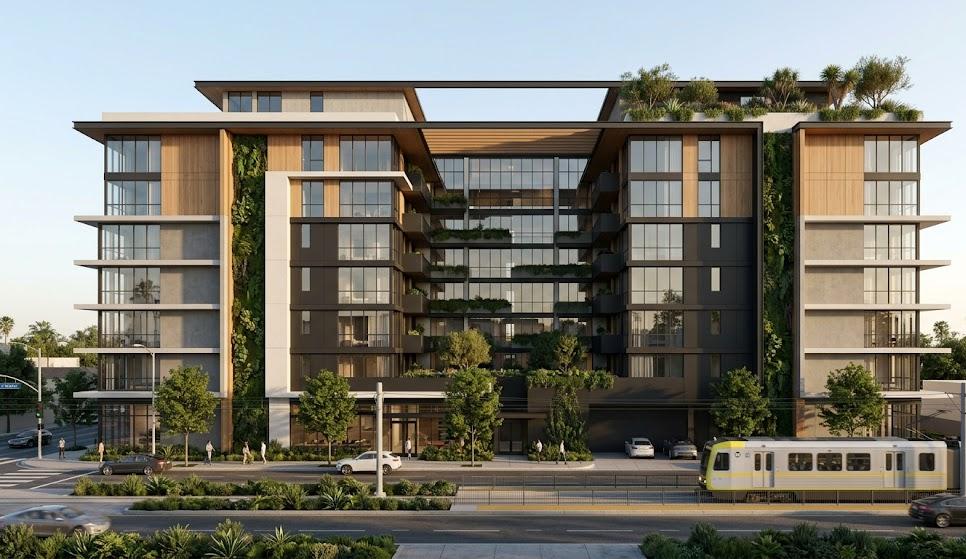
Our upcoming signature development—a 7-story, 80-unit mixed-use project along the Crenshaw Corridor—is the prime case study. By integrating CalGreen Tier 2 standards, we didn’t just access substantial density and Floor Area Ratio (FAR) bonuses via the TOC program; we created a blueprint for eco-resilient design. This project is a product of our conviction that building for tomorrow’s climate is essential for ensuring tomorrow’s valuations. The increased density lowers the per-unit cost of CalGreen compliance, making the overall investment thesis incredibly compelling.
The Investor Imperative: CalGreen as Asset Preservation
The market is moving toward assets that offer long-term resilience and lower operational risk. Institutional investors, capital partners, and commercial lenders are increasingly prioritizing Environmental, Social, and Governance (ESG) criteria. Assets that are ‘CalGreen optimized’ are naturally ‘ESG aligned.‘
This alignment is critical for exit cap rates. A future buyer will view a non-compliant or less efficient building as a ‘brown asset’ requiring costly future retrofits. This reality is compounded by new local dynamics like Measure ULA (the ‘Transfer Tax’), which changes the transaction math and puts a premium on assets that maximize long-term NOI to offset sales costs. A building designed to optimize water and power grids is an asset that preserves its core valuation long into the future.
Conclusion: The New Development Blueprint
In 2026, the question is not if you will comply with CalGreen; the question is how aggressively you will leverage it. The future of Los Angeles real estate is transit-oriented, dense, and inherently sustainable. At Ideal Residence, we have proven that sustainable development and superior investor returns are not mutually exclusive; they are intrinsically linked. CalGreen isn’t just a building code—it is the blueprint for the resilient L.A. skyline of tomorrow.
