
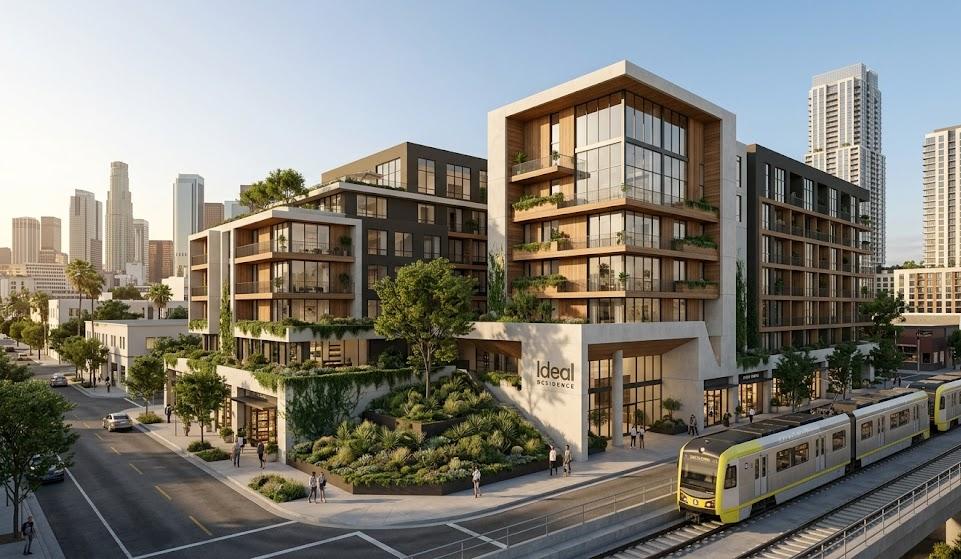
Downtown L.A. 2026: The Shift Toward Residential-First Urban Centers
The concept of the Central Business District is undergoing a profound evolution. Entering 2026, the traditional blueprint of a 9-to-5 commercial core has been permanently altered in Los Angeles. The primary driver of value in DTLA is no longer commercial office density, but high-quality, sustainable residential integration.
This shift toward “Residential-First Urban Centers” is the defining macroeconomic trend of the post-pandemic era. At Ideal Residence, we view this transition not merely as a repurposing of space, but as a critical de-risking strategy that secures stable Net Operating Income (NOI) while fostering resilient local economies.
From Commuting to Community: The DTLA Transformation
For decades, DTLA relied on a heavy influx of daytime office workers to support local businesses. The decentralized workforce model, now fully matured in 2026, has rendered that model obsolete. Institutional capital is now laser-focused on hyper-localized, mixed-use ecosystems.
The properties positioned for the highest asset valuation are those that successfully blend housing, localized retail, and transit access. We are seeing a structural migration of investment interest from high-rise office towers (facing valuation adjustments) to sustainable multi-family assets that offer a robust live-work-play balance.
Sustainable, Transit-Oriented Density (TOC)
This residential migration relies heavily on leveraging regional transit infrastructure. The success of these new urban centers is inextricably linked to Los Angeles’ Transit-Oriented Communities (TOC) Incentive Program. TOC metrics provide crucial Floor Area Ratio (FAR) bonuses and parking reductions that make high-density, mixed-income projects financially viable.
By utilizing these incentives, developers can maximize unit counts near high-frequency transit hubs. Ideal Residence pioneered this approach along key South L.A. transit corridors, such as the Crenshaw Boulevard stretch served by the K Line. These developments are not just about adding housing units; they are about integrating with the existing community fabric while lowering carbon footprints through reduced car dependency.
Eco-Resiliency: Future-Proofing Urban Assets
In 2026, sustainability is no longer a ‘nice-to-have’; it is a critical component of institutional risk mitigation. “Residential-First” urban cores require infrastructure that meets rigorous eco-resilient design standards and CalGreen building codes.
Future-proofed assets integrate smart-grid technology, mass timber construction, and drought-tolerant landscaping. This operational approach significantly reduces Operating Expenses (OpEx) while commanding premium rents from environmentally conscious tenants. By reducing the overall Carbon Utilization Intensity (CUI) of a development, we generate long-term asset value that outpaces traditional code-compliant buildings.
Case Study: De-Risking via Strategic Placement
The blueprint for this urban future is visible in Ideal Residence’s upcoming project along the Crenshaw Corridor. While outside the DTLA immediate core, this 7-story, 80-unit development exemplifies the core principles of the residential-first model.
By identifying a strategic infill location, utilizing TOC density bonuses, and integrating sustainable architecture, we are creating an asset that serves the community and delivers reliable, long-term returns. This project serves as a microcosm of the successful future of DTLA itself: transit-adjacent, sustainable, and fundamentally residential.
The Investor Perspective: Secure the New Urban Skyline
The transition to residential-first urban centers in Downtown L.A. represents the single greatest opportunity for capital reallocation in the SoCal multi-family market in this decade. While regulatory challenges like Measure ULA have affected traditional deal structures, the long-term demand for high-quality, sustainable housing near transit remains robust.
The L.A. skyline of 2026 is defined not by the tallest office tower, but by the most resilient, vibrant, and sustainable communities. For institutional investors seeking stable yield and exposure to the new urban economy, the mandate is clear: invest in the residential future of Los Angeles
