
Navigating Southern California’s 2026 Macroeconomic Landscape
As Los Angeles real estate enters 2026, institutional investors face a shifting macroeconomic paradigm defined by persistent capital constraints, elevated borrowing costs, and stricter municipal regulations. In this climate, traditional linear construction models—characterized by high material waste and volatile OpEx—are increasingly untenable. Sustainable, transit-oriented development is no longer just an ESG checkbox; it is the primary driver of asset valuation and risk mitigation across Southern California.
Under the leadership of Ideal Residence, our approach reframes large-scale development through the lens of circular economy principles. By engineering waste out of the supply chain from inception, we protect Net Operating Income (NOI) while maximizing Floor Area Ratio (FAR) bonuses under municipal incentive frameworks.
The Regulatory Imperative: Aligning TOC and CalGreen Standards
Developing high-density residential assets in urban infill markets requires rigorous navigation of municipal frameworks. In the Crenshaw Corridor and greater South L.A., the Transit-Oriented Communities (TOC) Incentive Program provides vital density bonuses for projects adjacent to K Line infrastructure. However, maximizing these incentives demands operational excellence in sustainable construction.
We integrate strict CalGreen Building Standards with closed-loop material sourcing, significantly reducing landfill diversion burdens and satisfying Measure ULA requirements. This proactive compliance shields our institutional partners from regulatory penalties while accelerating project velocity.
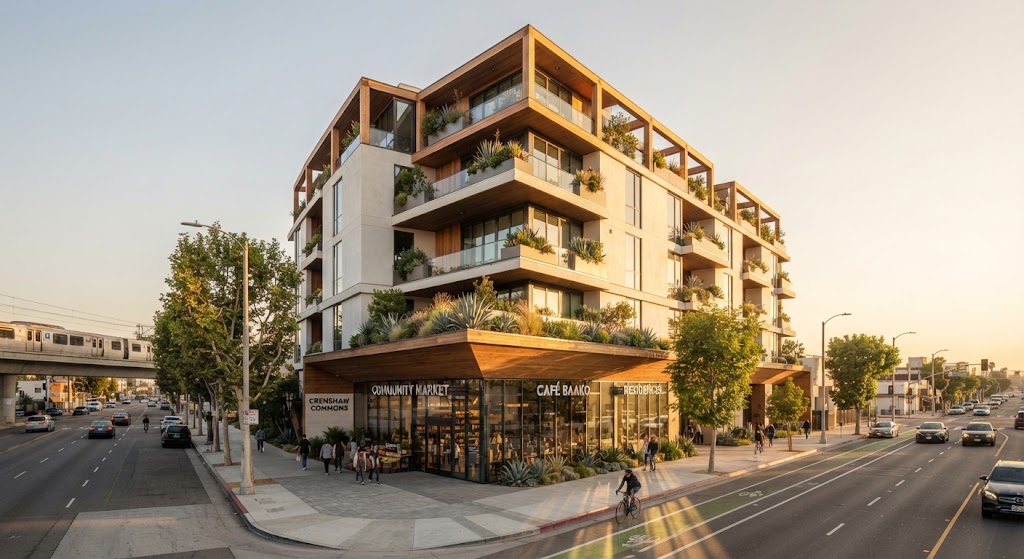
Case Study in Practice: The Crenshaw Corridor Mixed-Use Project
Our upcoming 7-story, 80-unit mixed-use development along the K Line serves as a live benchmark for circular construction in Southern California. Key operational strategies include:
-
Precision Prefabrication: Utilizing mass timber structural components and modular panelization to minimize on-site cutting waste by up to 35%.
-
Material Reclamation Loops: Partnering with regional processors to integrate recycled aggregate concrete and reclaimed architectural finishes.
-
Smart-Grid Integration: Embedding IoT-enabled sub-metering and decentralized renewable energy storage to drive long-term operational efficiency and suppress building OpEx.
By treating waste streams as valuable secondary resources, this project de-risks development execution and establishes a new benchmark for institutional-grade multifamily assets in urban core submarkets.
Conclusion: Shaping the Future of the L.A. Skyline
The evolution of the Los Angeles skyline relies on the intersection of institutional discipline and sustainable innovation. Circular construction methodologies offer private equity partners and commercial lenders a robust mechanism to enhance asset longevity and insulate cash flows against future resource shocks. As Ideal Residence continues to scale its pipeline along vital transit corridors, we invite forward-thinking joint-venture partners to join us in redefining urban development.
