
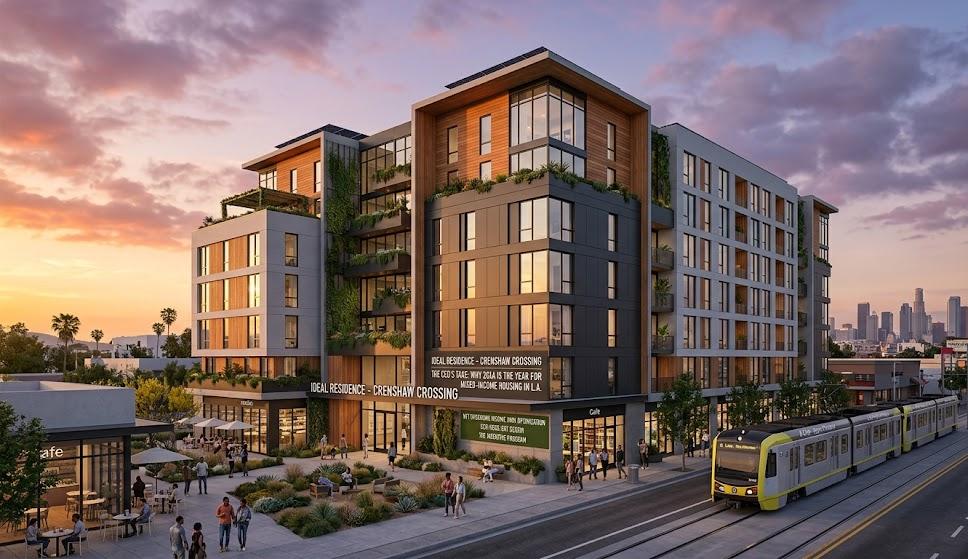
The CEO’s Take: Why 2026 is the Year for Mixed-Income Housing in L.A
By Lara Okunubi, CEO, Ideal Residence
Entering 2026, the Los Angeles multi-family housing sector stands at its most significant inflection point since the start of the decade. The traditional, single-track approach to development—the strict bifurcation of luxury-only or fully subsidized affordable projects—no longer meets the financial or regulatory demands of the market. As we evaluate current macroeconomic trends alongside hyper-local factors, my outlook is definitive: 2026 is the definitive year for mixed-income housing in Los Angeles. This model, blending market-rate and deed-restricted units, is the singular strategy capable of addressing L.A.’s profound housing shortage while providing the robust, risk-adjusted returns institutional capital requires.
The Convergence of Market and Macroeconomic Forces
The fundamental argument for mixed-income stems from a collision of economic necessity. In 2026, construction costs remain historically high, despite a stabilization in certain materials. Institutional lenders have largely retreated from high-leverage positions, scrutinizing project viability with intense rigor. When isolated, the numbers for traditional 100% affordable projects, which rely on layers of competitive tax credits, are often insufficient to generate necessary Net Operating Income (NOI). Conversely, the demand for pure luxury is softening as high interest rates constrain upper-end affordability. Mixed-income development breaks this impasse, creating a diversified revenue stream that de-risks the asset for institutional investors and private equity.
De-risking through Regulatory Incentives
In the context of L.A.‘s restrictive land use, regulatory compliance is where mixed-income truly proves its financial value. Our investment strategy leans heavily into the City’s Transit-Oriented Communities (TOC) Incentive Program. TOC is not merely a policy gesture; it is a financial accelerator. By committing to specific ratios of affordable units, Ideal Residence secures massive Floor Area Ratio (FAR) bonuses and parking reductions. This allows for significantly greater density than base zoning would permit, drastically lowering the per-unit cost basis. Leveraging these tier-level bonuses is the key to unlocking core urban areas like the Crenshaw Corridor and South L.A. that were previously economically unfeasible.
A Model of Provenance: The Crenshaw Corridor Development
We are moving past abstract arguments. The strongest proof-of-concept in our portfolio is the upcoming mixed-income development in the heart of South L.A.’s Crenshaw Corridor. This 7-story, 80-unit, mixed-use project was strategically placed to capture the revitalization powered by the new K Line infrastructure. By utilizing Tier 3 TOC bonuses, we increased our density by 70% and substantially reduced operating expenses (OpEx) related to structured parking. The residential mix (80% market rate, 20% dedicated to extremely low income) provides a reliable cash flow. We also prioritized long-term asset valuation by integrating robust eco-resilient design, including smart-grid capability and ultra-high-efficiency systems. This foresight de-risks the asset against future energy regulations while significantly lowering recurring utility costs.
Sustainable Design as Value Retention Strategy
The future of asset valuation in California is inextricably linked to sustainability. A property’s resilience to climate events and energy grid volatility is now a primary diligence metric for sophisticated limited partners. In 2026, building simply to current code—even the strict CalGreen Building Standards—is inadequate. Every Ideal Residence project integrates sustainable architecture (like mass timber accents, smooth concrete for thermal mass, and high-performance glazing) with integrated urban greenery and drought-tolerant native California landscaping. This commitment to ESG (Environmental, Social, and Governance) principles is not merely altruistic; it is a direct driver of long-term NOI and capital appreciation.
Moving Capital Off the Sidelines: The 2026 Imperative
My call to action is for partners ready to capitalize on this alignment of market conditions, policy, and demand. The Los Angeles skyline will be shaped by those developers who synthesize urban density, transit proximity, and a diverse tenant mix. By embracing the mixed-income model, fueled by strategic infrastructure like the K Line, we can create the sustainable, community-integrated housing L.A. needs while achieving superior risk-adjusted returns for our joint-venture partners. The inflection point is now.
