
Navigating Risk and Resilience in Southern California’s Urban Core
Navigating the 2026 macroeconomic landscape across Southern California requires an uncompromising commitment to structural resilience and financial precision. As rising capital costs and stricter municipal mandates reshape the Los Angeles real estate market, institutional investors and private equity partners are re-evaluating how large-scale mixed-use developments are underwritten. Mitigating risk is no longer simply about conservative leverage; it requires an integrated approach combining transit-oriented development (TOD) incentives, eco-resilient design, and advanced smart-grid integration to safeguard long-term Net Operating Income (NOI) and asset valuation.
At Ideal Residence, our core thesis centers on aligning urban density with rigorous risk mitigation. By deploying capital strategically along high-capacity transit corridors, we transform regulatory frameworks into tangible economic advantages.
Regulatory Alignment and Floor Area Ratio (FAR) Optimization
In Southern California, regulatory compliance serves as a primary driver of project viability. Navigating frameworks such as the Transit-Oriented Communities (TOC) Incentive Program and CalGreen Building Standards allows forward-thinking developers to unlock substantial Floor Area Ratio (FAR) bonuses and parking reductions.
-
Density Bonus Utilization: Maximizing allowable FAR near major transit infrastructure directly reduces per-unit land acquisition costs.
-
Expedited Entitlements: Leveraging TOC tiers streamlines municipal approvals, mitigating holding cost exposure and interest rate volatility during pre-development.
-
Navigating Measure ULA: Structuring capital stacks with expert tax and legal guidance ensures compliance and protects projected yields against transfer tax burdens.
The Crenshaw Corridor Case Study: Resilient Design in Action
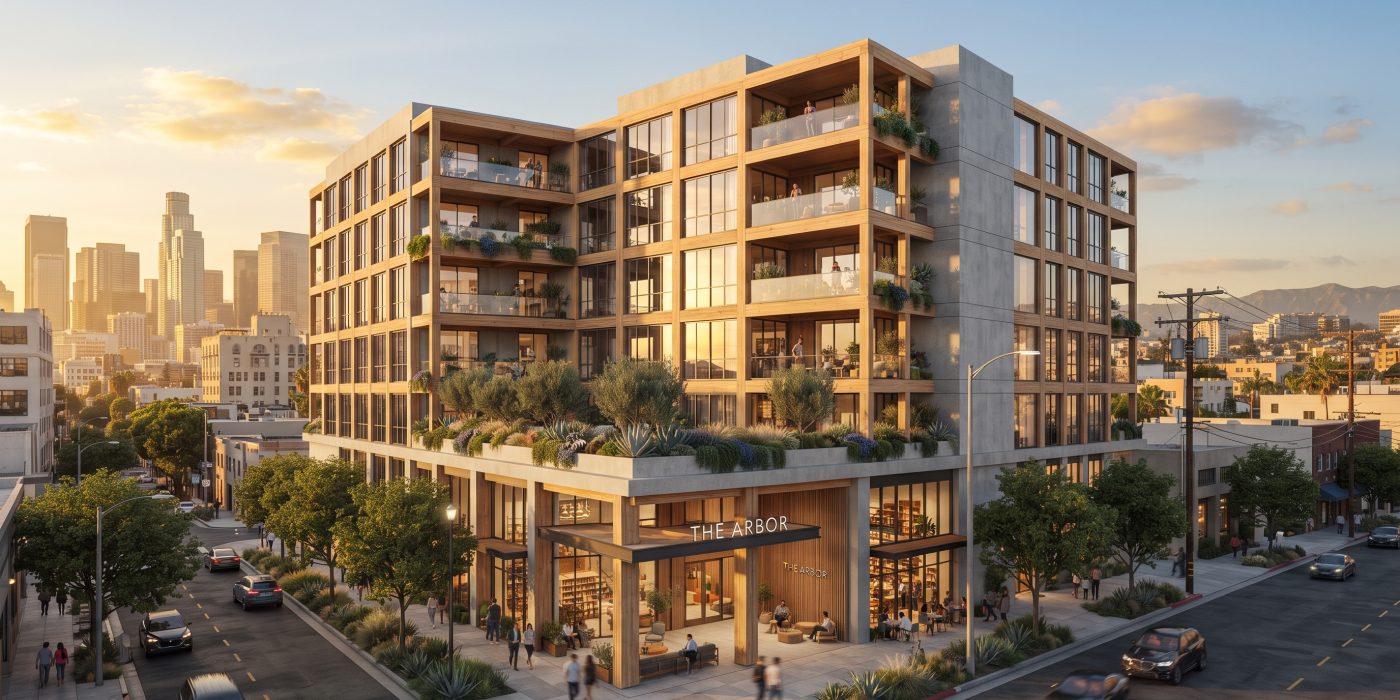
Our upcoming 7-story, 80-unit mixed-use development in the Crenshaw Corridor stands as a live case study in institutional de-risking. Situated directly adjacent to vital K Line infrastructure, this asset marries high-density urban housing with vibrant ground-floor commercial retail.
By integrating mass timber accents, smooth architectural concrete, and high-performance glazing, the development achieves superior energy efficiency while dramatically lowering ongoing Operating Expenses (OpEx). Furthermore, smart-grid energy storage and drought-tolerant native California landscaping insulate tenants and operators from utility spikes and severe regional climate pressures.
Financial Hedging and Asset Valuation Protection
Institutional lenders and commercial capital partners demand absolute clarity on downside protection. Sustainable mixed-use assets inherently outperform traditional asset classes by securing premium rental yields and maintaining high tenant retention. Eco-resilient design and transit-adjacent positioning protect against future obsolescence, ensuring resilient capitalization rates and robust long-term asset valuation across varying economic cycles.
Conclusion
The future of the Los Angeles skyline belongs to developments that successfully merge architectural distinction with institutional-grade risk management. As we scale our footprint across Southern California, Ideal Residence remains dedicated to delivering superior risk-adjusted returns for our investment partners. We invite forward-thinking private equity partners and commercial lenders to connect with our executive team regarding upcoming joint-venture opportunities.
