
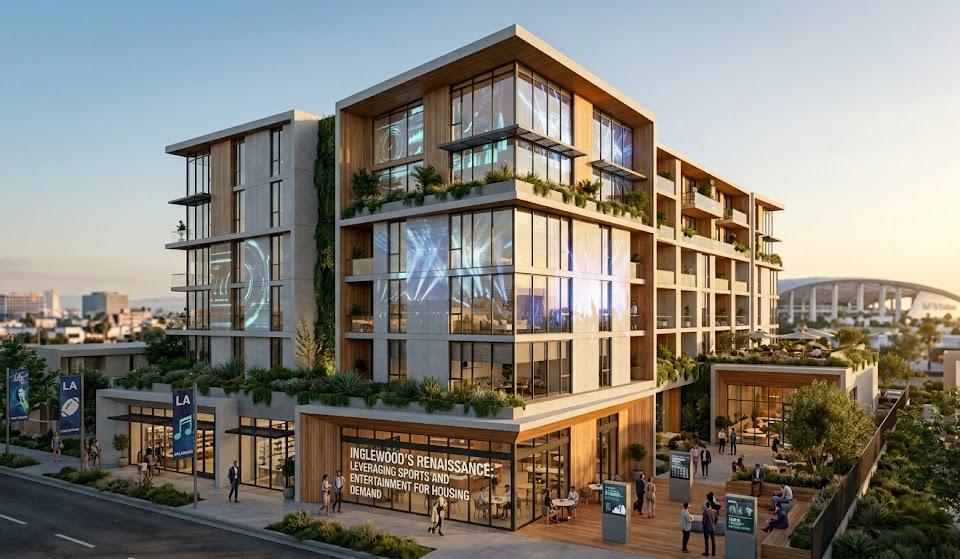
Inglewood’s Renaissance: Leveraging Sports and Entertainment for Housing Demand
The geopolitical and economic landscape of Los Angeles real estate is undergoing a fundamental paradigm shift. In 2026, the intersection of infrastructure investment and the experience economy is redefining where capital seeks returns in the multi-family sector. Nowhere is this more evident than in Inglewood. This municipality is transforming rapidly, and the catalyst is undeniable: the monumental scale of its sports and entertainment district.
This isn’t just a localized boom; it’s a structural realignment. It’s the moment when large-scale commercial success creates an intense, immediate need for institutional-grade housing solutions. Under the leadership of CEO Lara Okunubi, Ideal Residence has identified Inglewood as a primary example of where transit-oriented, sustainable development must scale to meet this surging demand.
The Entertainment Multiplier Effect
The SoFi Stadium, the Intuit Dome, and the surrounding venues have done more than create event-day traffic. They have seeded an entire ecosystem of ancillary businesses, creating a permanent workforce and attracting a demographic of affluent professionals seeking proximity to dynamic amenities. This activity acts as a potent multiplier effect on local economic output.
When billions of dollars are invested in iconic venues, a powerful magnetic draw occurs. The demand for housing near this nexus is no longer theoretical—it is an urgent operational requirement. This immediate need, when met with a chronic undersupply of modern housing, presents an exceptional investment profile.
De-risking via Infrastructure & Policy
Crucially, Inglewood’s renaissance is not occurring in a vacuum of speculative development. It is structurally reinforced by critical infrastructure. The K Line (Crenshaw/LAX Transit Project) provides a reliable connective tissue, linking the South L.A. and Inglewood corridors directly into the greater Los Angeles metropolitan network. This connectivity significantly de-risks multi-family investment by securing long-term tenant velocity.
Ideal Residence is proactively utilizing regulatory mechanisms designed to optimize this environment. The Transit-Oriented Communities (TOC) Incentive Program remains essential for achieving high-performance asset valuation. By leveraging significant Floor Area Ratio (FAR) bonuses in exchange for deep affordability components, we synthesize maximum yields with meaningful community benefit.
The Sustainable, High-Performance Mandate
However, the 2026 market demands more than prime location. Institutional partners and sophisticated tenants alike require assets with robust environmental, social, and governance (ESG) credentials. The Inglewood submarket, while booming, has many aging structures unable to provide the eco-resiliency necessary for long-term hold strategies.
Our signature approach—echoing our 80-unit project in the nearby Crenshaw Corridor—is the antidote to obsolete inventory. Ideal Residence is committed to delivering assets incorporating:
-
Eco-Resilient Design: Utilizing advanced envelope technologies and sustainable materials to reduce operating expenses (OpEx) while achieving CalGreen Building Standards certification.
-
Smart-Grid Integration: Forward-thinking energy systems that future-proof the asset and provide tenants with modern energy efficiency.
-
Net Operating Income (NOI) Optimization: Building green isn’t just an ethic; it is an economic imperative that lowers long-term operational costs and ultimately drives superior asset valuation.
Forward-Looking: Partnering for Impact
The narrative of Inglewood is a long-term economic realignment. It’s about recognizing the structural shift of Los Angeles and deploying capital effectively. This renaissance is only in its nascent phase. The upcoming 2026 World Cup match and the 2028 Olympic Games will only accelerate the demand for both short-term hospitality and, more critically, long-term residential solutions.
Ideal Residence invites institutional investors and joint-venture partners to engage in this transformation. The Inglewood housing market presents a unique window: the ability to invest in a market with high-velocity demand drivers (sports/entertainment/transit) while delivering essential, sustainable, and high-performance assets. We are building the infrastructure of opportunity, creating value that transcends the event cycle.
