
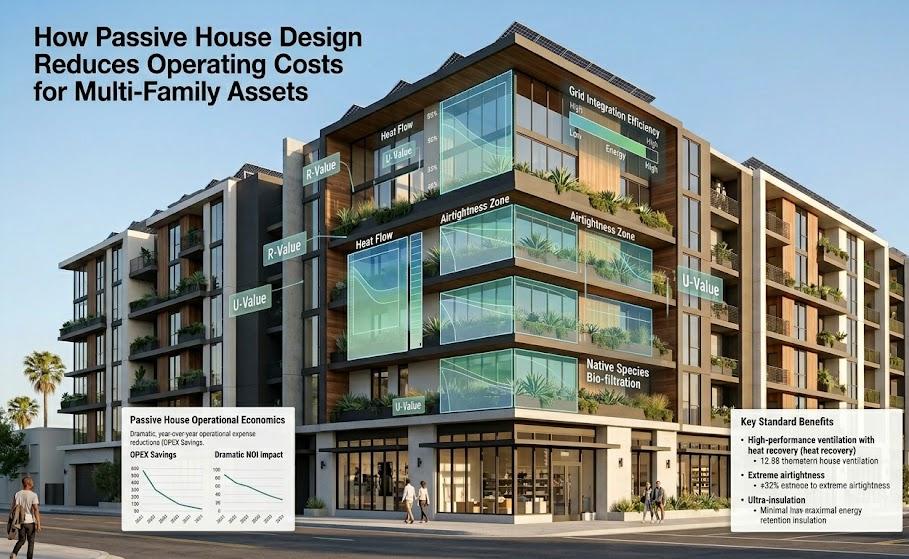
How Passive House Design Reduces Operating Costs for Multi-Family Assets
By Lara Okunubi, CEO, Ideal Residence
In 2026, the Los Angeles multi-family market faces a crucial pivot point. Developers and institutional investors are increasingly caught between rising construction and utility costs and stringent environmental mandates, such as the Measure ULA transfer tax and the California Green Building Standards Code (CalGreen). Simultaneously, discerning tenants are demanding sustainable living spaces that offer superior air quality and reduced energy burdens. The traditional response—marginal energy-efficiency upgrades—is no longer a viable long-term strategy. To genuinely de-risk assets and secure superior returns in the Southern California landscape, the investment thesis must pivot toward Passive House design.
Passive House as a Financial Tool: Beyond “Greenwashing”
Passive House design is not just an environmental accolade; it is a rigorous engineering standard focused on optimizing a building’s thermal performance to an extreme degree. It relies on super-insulation, airtight construction, high-performance windows, thermal-bridge-free detailing, and mechanical ventilation with heat recovery. While this requires a modest uplift in initial hard costs, typically ranging from 3% to 5% for experienced developers, the immediate impact on a building’s operational pro-forma is profound and permanent.
The primary financial metric optimized by Passive House is Net Operating Income (NOI). It achieves this by aggressively targeting the asset’s most significant recurring operational expenditure: energy usage.
Drastically Reducing Operating Expenses (OpEx) through Energy Arbitrage
Traditional multi-family buildings devote a significant portion of their OpEx to space heating and cooling. Passive House design can reduce these energy demands by up to 90% compared to typical existing housing stock. In the Los Angeles climate, where extreme heat waves are becoming more frequent, the monetary savings are substantial.
Minimized Utility Bills: By maintaining consistent interior temperatures with negligible active heating or cooling, a Passive House asset effectively isolates its cash flow from the volatility of local energy markets. This stability creates a significant competitive advantage when structuring tenant utility agreements, whether sub-metered or RUBS (Ratio Utility Billing System).
Grid Resiliency & Smart-Grid Integration: The reduced total energy load makes Passive House developments ideal candidates for solar photovoltaic (PV) and battery storage integration. In transit-oriented communities like the Crenshaw Corridor, where the grid may face strain, this allows the asset to engage in smart-grid energy arbitrage, further enhancing NOI by generating revenue through energy export or minimizing peak-demand charges.
The Synergy: Passive House + LA’s TOC Program
Ideal Residence is proactively applying these principles to its upcoming signature project: a 7-story, 80-unit mixed-use development in South L.A. This project leverages Los Angeles’s Transit-Oriented Communities (TOC) Incentive Program, maximizing density near key K Line infrastructure. The financial calculus is synergistic: the extra density allowed by the TOC (increased FAR bonuses) offsets the marginally higher per-square-foot construction costs of Passive House construction, while the resulting asset achieves ultra-low long-term operating costs and commands premium rents due to high tenant comfort and health standards.
Sustained Asset Valuation and Future-Proofing
Furthermore, the long-term asset valuation for a Passive House development is consistently higher than a conventional build. These assets are inherently eco-resilient, designed to maintain habitable conditions during grid failures or extreme weather events. As municipalities in Southern California enact stricter building emissions standards, Passive House buildings are already “future-proofed” against costly required retrofits, further de-risking the investment over a 10- or 20-year hold period.
