
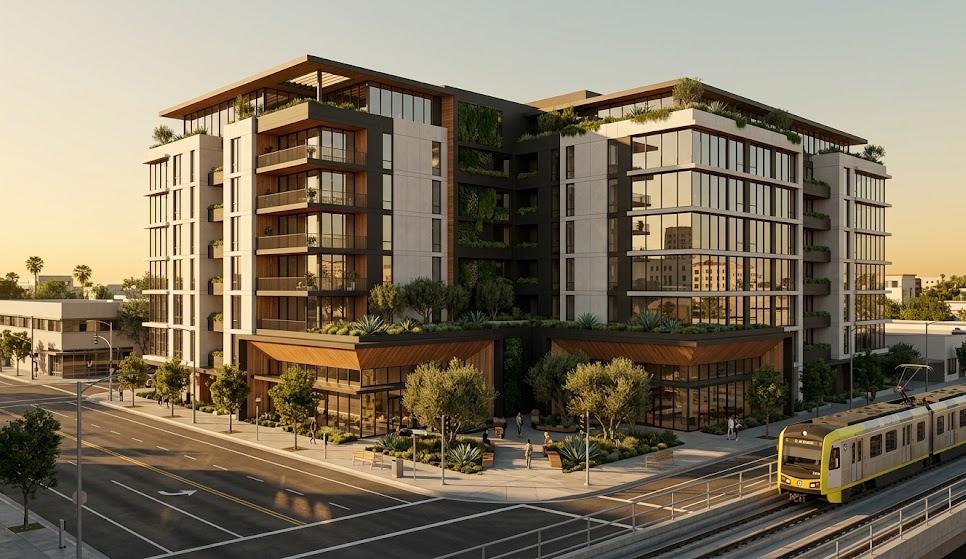
Decarbonizing the Crenshaw Corridor: A Blueprint for Sustainable Urbanism
By Lara Okunubi, CEO, Ideal Residence
The Los Angeles multi-family real estate landscape is undergoing a profound structural shift. In 2026, the convergence of stringent regulatory mandates, escalating institutional ESG (Environmental, Social, and Governance) requirements, and shifting tenant demographics has made conventional, carbon-intensive development an obsolete model. For institutional investors, the path to long-term asset value and de-risking portfolios no longer merely skirts sustainability; it requires a radical commitment to deep decarbonization. Nowhere is this opportunity more defined than in South L.A.’s historic Crenshaw Corridor.
Ideal Residence is not just observing this transformation; we are engineering it. As we deploy capital into key Transit-Oriented Communities (TOC), our mandate is clear: deliver superior risk-adjusted returns by developing the next generation of eco-resilient, net-zero-ready housing infrastructure.
The Convergence of Transit and High-Performance Design
Decarbonization in an urban context is intrinsically linked to mobility. The completion of the K Line infrastructure has fundamentally redefined connectivity in the Crenshaw Corridor, creating a uniquely fertile ground for sustainable urbanism. This transit investment allows us to leverage high-leverage density bonuses while simultaneously slashing the carbon footprint associated with resident transportation.
However, true sustainable urbanism goes beyond proximity to rail. We view the building shell itself as a critical mechanism for carbon reduction and operational efficiency.
Engineering NOI through Energy Efficiency
For our upcoming 7-story, 80-unit mixed-use development on Crenshaw Blvd, we are moving beyond CalGreen Building Standards to implement a vertical integration of smart-grid technologies and high-performance building systems.
-
Mass Timber Hybrid Structures: To address embodied carbon—the emissions generated during construction—we are utilizing mass timber components. This not only sequesters carbon but accelerates construction timelines, reducing localized pollution and interest carry.
-
Passive Survivability and Systems: Our designs prioritize high-performance glazing, enhanced thermal insulation, and passive cooling strategies. This drastically reduces energy demand for HVAC, which traditionally dominates building OpEx (Operating Expenses).
-
Smart-Grid Integration: The project will feature an advanced energy management system coupled with on-site solar storage. This allows the asset to balance loads, draw grid power only during off-peak hours, and integrate seamlessly with a circular energy economy.
By ruthlessly optimizing energy consumption, we directly enhance Net Operating Income (NOI). Sustainable design is no longer a cost center; it is a critical driver of asset valuation in a market that increasingly penalizes inefficient structures.
Navigating the Regulatory Landscape: Measure ULA and TOC Incentives
In the current Los Angeles regulatory environment, successful execution requires sophistication. While Measure ULA (the “mansion tax”) has created headlines regarding its impact on transfer taxes, our strategy focuses on leveraging long-term, pro-density mechanisms.
The L.A. Transit-Oriented Communities (TOC) Incentive Program is central to our blueprint. By prioritizing high-percentage affordable housing ratios within our Crenshaw development, we maximize Floor Area Ratio (FAR) bonuses and density increases. This allows us to scale the project efficiently, optimizing the land cost per unit while meeting critical community housing needs.
This approach de-risks the entitlement process and ensures our projects align with municipal goals, creating a streamlined path to horizontal and vertical development.
A Future-Proof Investment in South L.A.
Decarbonizing the Crenshaw Corridor is not a hypothetical exercise; it is an imperative for the future of Los Angeles real estate. By blending institutional-grade financial analysis with cutting-edge sustainable architecture, Ideal Residence is creating a new asset class.
The skyline of Los Angeles is being redrawn, and the buildings that define it must be resilient, efficient, and equitable. For joint-venture partners and institutional lenders who recognize the shifting tides of regulation and tenant demand, this blueprint offers the definitive path forward.
Sustainable urbanism is the future of core investment in Southern California. We invite you to build it with us.
