
Adaptive Reuse vs. New Construction: Which is More Sustainable in L.A.?
The Los Angeles multi-family housing market in 2026 demands a radical recalibration of how developers approach capital allocation, environmental impact, and asset valuation. With stringent municipal regulations and shifting macroeconomic pressures, institutional investors are no longer asking whether sustainability matters—they are evaluating the carbon and financial lifecycle of how that sustainability is achieved. Under the leadership of CEO Lara Okunubi, Ideal Residence continues to pioneer high-impact, transit-oriented development across Southern California, balancing the delicate scales between adaptive reuse and ground-up new construction.
The Regulatory Framework: Navigating L.A.’s Urban Mandates
Evaluating sustainability in the Los Angeles basin requires deep familiarity with a complex web of environmental and zoning policies. Ground-up developments and heavy retrofits must navigate the rigorous requirements of the CalGreen Building Standards, alongside municipal initiatives like Measure ULA, which impacts high-value property transfers.
Simultaneously, developers leveraging the Transit-Oriented Communities (TOC) Incentive Program unlock vital density bonuses and parking reductions, provided their projects anchor themselves near high-capacity transit infrastructure. Whether a developer chooses an adaptive reuse model or a clean slate with new construction, compliance and optimization under these frameworks dictate long-term Net Operating Income (NOI) and asset stability.
Adaptive Reuse: Preserving Carbon Equity and Streamlining Timelines
Adaptive reuse projects—transforming underutilized commercial or industrial spaces into vibrant residential units—offer a compelling hedge against rising construction costs and material inflation. By preserving the existing structural concrete and steel, developers instantly retain a massive amount of embodied carbon.
-
Embodied Carbon Savings: Retaining a building’s primary skeleton bypasses the carbon-intensive phases of demolition, excavation, and foundational pouring.
-
Speed-to-Market: Bypassing lengthy initial zoning hearings and protracted site prep significantly curtails carrying costs, protecting operational OpEx during pre-development.
-
Inherent Character: Historic textures and unique architectural volumes command strong rental premiums among urban demographic segments seeking authentic neighborhood integration.
However, adaptive reuse is not without hurdles. Unforeseen seismic retrofitting requirements, asbestos abatement, and outdated MEP (Mechanical, Electrical, and Plumbing) systems can quickly introduce capital expenditures that erode projected yields if not properly underwritten.
New Construction: Maximizing Smart-Grid Integration and Efficiency
While adaptive reuse wins on embodied carbon, ground-up new construction provides an unmatched canvas for state-of-the-art environmental engineering and maximized Floor Area Ratio (FAR) utilization.
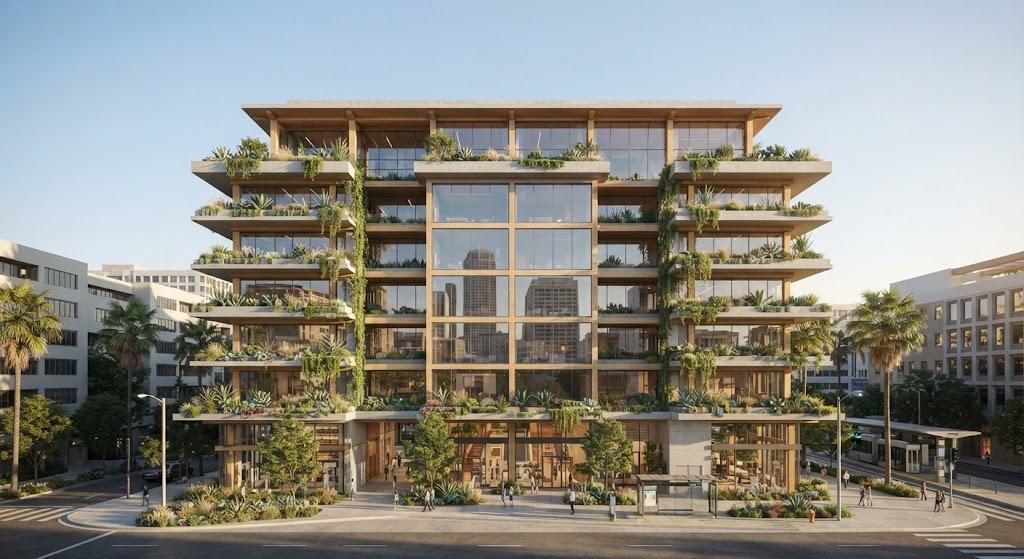
Our upcoming 7-story, 80-unit mixed-use development situated directly within the Crenshaw Corridor serves as a live institutional case study. Leveraging the K Line infrastructure, this ground-up asset integrates advanced smart-grid technologies, high-performance thermal envelope glazing, and solar arrays that feed directly into localized battery storage systems.
-
Optimized Floor Plates: Designing from the ground up allows for ideal spatial efficiency, ensuring every square foot contributes directly to revenue generation.
-
Net-Zero Readiness: Modern materials and high-efficiency variable refrigerant flow (VRF) HVAC systems drastically slash long-term operational expenses.
-
De-Risking Maintenance: Modern utility networks minimize near-term maintenance liabilities compared to retrofitted historical assets, offering institutional lenders a predictable, low-variance cash flow profile.
Strategic Synthesis: Financial Viability Meets Eco-Resilient Design
For private equity partners and commercial lenders, the choice between adaptive reuse and new construction ultimately boils down to a risk-adjusted return analysis. Adaptive reuse excels at mitigating timeline risk and preserving historical density, while new construction dominates in operational energy efficiency, long-term asset valuation, and scalable smart-grid integration.
As L.A. continues its evolution into a transit-first metropolis, the most successful developers will apply a site-specific lens rather than a dogmatic formula. By balancing eco-resilient design with rigorous financial underwriting, Ideal Residence is proving that sustainable development is not merely a regulatory checkbox—it is the ultimate catalyst for generational real estate value.
